Tampilkan postingan dengan label History. Tampilkan semua postingan

Blog

A blog (a blend of the term web log) is a personal journal published on the World Wide Web consisting of discrete entries ("posts") typically displayed in reverse chronological order so the most recent post appears first. Blogs are usually the work of a single individual, occasionally of a small group, and often are themed on a single subject. Blog can also be used as a verb, meaning to maintain or add content to a blog.

The emergence and growth of blogs in the late 1990s coincided with the advent of web publishing tools that facilitated the posting of content by non-technical users. (Previously a knowledge of such technologies as HTML and FTP had been required to publish content on the Web.)

Although not a must, most good quality blogs are interactive, allowing visitors to leave comments and even message each other via GUI widgets on the blogs and it is this interactivity that distinguishes them from other static websites. In that sense, blogging can be seen as a form of social networking. Indeed, bloggers do not only produce content to post on their blogs but also build social relations with their readers and other bloggers.

Many blogs provide commentary on a particular subject; others function as more personal online diaries; yet still others function more as online brand advertising of a particular individual or company. A typical blog combines text, images, and links to other blogs, Web pages, and other media related to its topic. The ability of readers to leave comments in an interactive format is an important part of many blogs. Most blogs are primarily textual, although some focus on art (art blog), photographs (photoblog), videos (video blogging or vlogging), music (MP3 blog), and audio (podcasting). Microblogging is another type of blogging, featuring very short posts.

As of 16 February 2011, there were over 156 million public blogs in existence.
-------------------------------------------------------------------------------------------------------------------------------------------------------------
 
History

The term "weblog" was coined by Jorn Barger on 17 December 1997. The short form, "blog," was coined by Peter Merholz, who jokingly broke the word weblog into the phrase we blog in the sidebar of his blog Peterme.com in April or May 1999. Shortly thereafter, Evan Williams at Pyra Labs used "blog" as both a noun and verb ("to blog," meaning "to edit one's weblog or to post to one's weblog") and devised the term "blogger" in connection with Pyra Labs' Blogger product, leading to the popularization of the terms.

History of the Internet

The history of the Internet starts in the 1950s and 1960s with the development of computers. This began with point-to-point communication between mainframe computers and terminals, expanded to point-to-point connections between computers and then early research into packet switching. Packet switched networks such as ARPANET, Mark I at NPL in the UK, CYCLADES, Merit Network, Tymnet, and Telenet, were developed in the late 1960s and early 1970s using a variety of protocols.

History of computing hardware

The history of computing hardware is the record of the ongoing effort to make computer hardware faster, cheaper, and capable of storing more data.

Computing hardware evolved from machines that needed separate manual action to perform each arithmetic operation, to punched card machines, and then to stored-program computers. The history of stored-program computers relates first to computer architecture, that is, the organization of the units to perform input and output, to store data and to operate as an integrated mechanism (see block diagram to the right).

History of Facebook

Facemash
In early 2003, Adam D'Angelo, then a Caltech student who had been Mark Zuckerberg's supporter in highschool, had developed the experimental, rudimentary social networking web site Buddy Zoo, that was utilized by many thousands of individuals before D'Angelo shut it down. That summer, Zuckerberg and friends who were conjointly laptop science students worked coding for the summer in Boston and mentioned the implication of D'Angelo's website's success with regard to the longer term of social networking on the web.
In the fall, Zuckerberg, returning for his sophomore year at Harvard, wrote CourseMatch, a briefly fashionable web site that helped Harvard students fathom what courses their friends were taking;
and then, on October twenty eight, 2003, he wrote Facemash, a web site that, per the Harvard Crimson, represented a harvard University version of Hot or Not.
That night, Zuckerberg created the subsequent blog entries:
 i am to a small degree intoxicated, not gonna lie. therefore what if it is not even ten pm and it is a Tuesday night? What? The Kirkland [dorm] facebook is open on my desktop and a few of those individuals have pretty horrendous facebook pics. I nearly wish to place a number of these faces next to photos of cattle and have individuals vote on that is a lot of enticing.
    —9:48 pm

    Yea, it's on. i am not specifically certain how the cattle are about to work into this whole issue (you cannot very ever make sure with cattle...), however i favor the thought of comparing 2 individuals along.
    —11:09 pm

    Let the hacking begin.
    —12:58 am

History of YouTube


YouTube's early headquarters in San Mateo
YouTube's headquarters in San Bruno from 2006 to 2010
YouTube  is a video-sharing website, created by three former PayPal employees in February of 2005, on which users can upload, share and view videos. The site was founded by Chad Hurley, Steve Chen and Jawed Karim, who were all early employees of PayPal. Prior to PayPal, Hurley studied design at Indiana University of Pennsylvania. Chen and Karim studied computer science together at the University of Illinois at Urbana-Champaign. The domain name "YouTube.com" was activated on February 14, 2005, and the website was develop

History of Google


Google's homepage 1998–1999

Early history

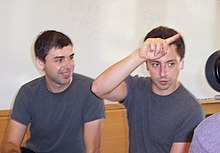
Larry Page and Sergey Brin in 2003
Google began in March 1996 as a research project by Larry Page and Sergey Brin, Ph.D. students at Stanford working on the Stanford Digital Library Project (SDLP). The SDLP's goal was “to develop the enabling technologies for a single, integrated and universal digital library." and was funded through the National Science Foundation among other federal agencies. In search for a dissertation theme, Page considered—among other things—exploring the mathematical properties of the World Wide Web, understanding its link structure as a huge graph. His supervisor Terry Winograd encouraged him to pick    this idea (which Page later recalled as "the best
advice I ever got") and Page focused on the problem of finding out which web pages link to a given page, considering the number and nature of such backlinks to be valuable information about that page (with the role of citations in academic publishing in mind). In his research project, nicknamed